

🌶️ Drip vs. Sprinkler Irrigation for Peppers in the Appalachian Foothills

Updated: Apr 19
Why a Comprehensive Irrigation Strategy Wins in High Tunnels for Peppers
Growing peppers in the Appalachian foothills isn’t just about heat and soil — it’s about managing water with precision. Here in Blountville, Tennessee, where humidity swings, summer heat spikes, and unpredictable rainfall are the norm, irrigation becomes one of the most important decisions a grower can make.
Most gardeners and farmers ask the same question: “Which is better — drip irrigation or sprinkler irrigation?”
The truth is, neither system alone gives peppers everything they need. The real magic happens when you combine them into a comprehensive irrigation strategy that supports plant health, pollination, and yield from transplant to harvest.
🌱 Understanding Pepper Water Needs in the Appalachian Region
Peppers thrive when the root zone stays consistently moist, the canopy stays cool, and the microclimate stays stable. In a high tunnel — where temperatures can swing dramatically in a single afternoon — irrigation becomes a tool for microclimate control, not just watering.
Key environmental challenges in Northeast Tennessee include:
high humidity swings that affect pollen viability
sudden heat spikes that cause blossom drop
dust accumulation inside tunnels that interferes with pollination
uneven soil moisture during dry spells
A single irrigation method can’t manage all of these variables. But a comprehensive irrigation strategy can.
💧 Drip Irrigation: Precision at the Root Zone

Drip irrigation is the backbone of modern pepper production — especially in high tunnels.
Benefits of Drip Irrigation
precise water delivery directly to the root zone
reduced foliar disease because leaves stay dry
improved fertilizer efficiency through fertigation
stable soil moisture that prevents blossom drop
lower water use compared to overhead systems
Scientific Insight
Drip irrigation increases pepper yield by improving water‑use efficiency and reducing evaporation losses. Stable root moisture also keeps flowers fertile — a major factor in fruit set.
Limitations
no canopy cooling
no dust removal
no humidity modulation
Drip is essential — but it’s not complete.
🌦️ Sprinkler Irrigation: Microclimate Control for High Tunnels
Sprinkler irrigation gets a bad reputation because of disease concerns, but when used strategically, it becomes a powerful tool for microclimate management.
Benefits of Sprinkler Irrigation
canopy cooling during heat spikes
uniform soil moisture early in the season
improved pollen shed through gentle airflow and humidity shifts
dust removal from flowers and leaves
Scientific Insight
Pepper pollen viability drops sharply above 32°C (89.6°F), and fertilization rates decline as temperatures approach 90°F. This threshold is documented in greenhouse pepper production guides such as the Johnny’s Selected Seeds Bell Pepper Greenhouse Guide, which notes reduced fruit set above 90°F due to impaired pollen function.
A brief overhead mist can drop canopy temperatures by 5–15°F, protecting fruit set.
Limitations
higher water use
increased foliar wetness
not ideal for daily irrigation
Sprinklers are a tool — not a primary system.
🌦️ Our 2025 Upgrade: Overhead Irrigation from Farmer’s Friend
This year, Harmony Springs Farm is implementing a new overhead irrigation system from Farmer’s Friend in both our high tunnel and caterpillar tunnel. This upgrade is a major step toward a fully integrated comprehensive irrigation strategy — combining the precision of drip with the microclimate control of overhead misting.
What This System Gives Us
uniform canopy cooling during Tennessee heat spikes
even early‑season soil hydration across long beds
better dust control inside the tunnels
improved pollen shed thanks to gentle airflow and humidity shifts
This system doesn’t replace drip — it enhances it.
Growers comparing irrigation setups can browse our Pepper Seeds category to see how different varieties respond.
🔬 Why This Matters for Pepper Production in the Appalachian Foothills
1. High tunnels trap heat — overhead irrigation releases it
Even in spring, a sunny afternoon can push tunnel temps above 100°F. Pepper pollen becomes non‑viable at these temperatures. A quick overhead cycle can drop canopy temps by 5–15°F, restoring pollen viability and protecting fruit set.
2. Dust is a hidden pollination killer
Dust on pepper flowers reduces pollen adhesion. Overhead irrigation rinses flowers clean without saturating the soil.
3. Humidity control is everything
Drip keeps humidity lower around the canopy. Overhead misting bumps humidity just enough to help pollen shed. Together, they create the sweet spot peppers need.
4. Better early‑season establishment
Overhead irrigation rehydrates the entire bed profile evenly — something drip alone can’t do.
🔄 Why a Hybrid System Is the Heart of a Comprehensive Irrigation Strategy
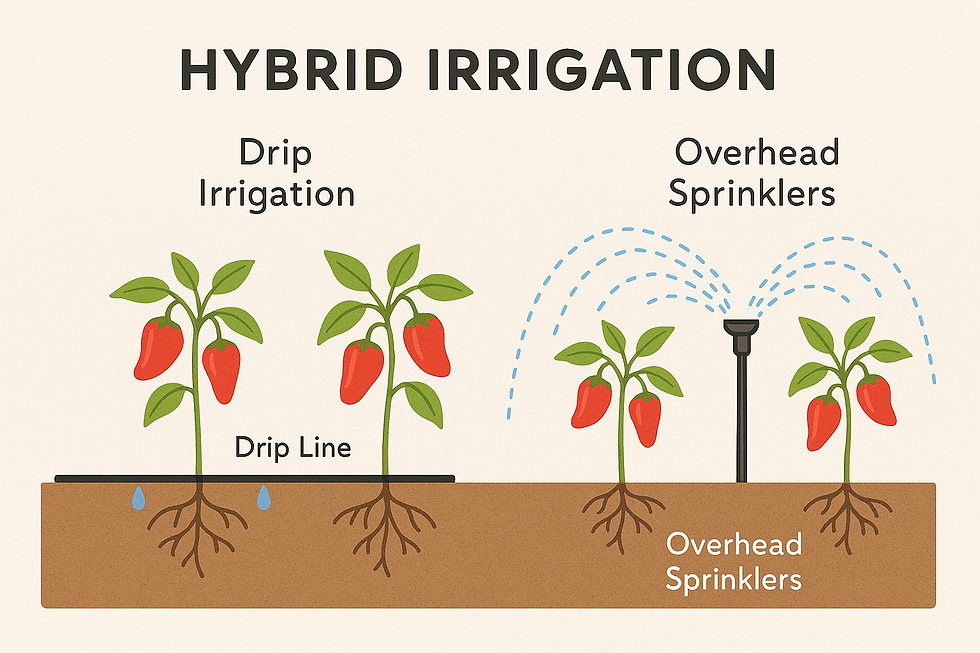
A hybrid system combines the strengths of both methods while minimizing their weaknesses. This is the foundation of a comprehensive irrigation strategy — one that adapts to plant needs, weather conditions, and tunnel microclimate.
1. Better Pollination
stable humidity from drip prevents pollen clumping
canopy cooling from sprinklers prevents pollen sterility
dust removal improves pollen adhesion
2. Stronger Root Systems
consistent moisture from drip
full soil profile hydration from overhead irrigation
3. Heat Stress Management
drip alone can’t cool plants
sprinklers reduce canopy temperature during heat waves
4. Disease Reduction
drip handles daily watering
sprinklers used sparingly avoid prolonged leaf wetness
5. Higher Yields
Healthy flowers + stable roots + controlled microclimate = more peppers.
🌶️ Harmony Springs Farm’s Approach
At Harmony Springs Farm, we use:
drip irrigation for daily moisture and fertigation
overhead sprinklers for canopy cooling, dust control, and early‑season soil hydration
This system keeps our peppers productive, our flowers fertile, and our high tunnel microclimate stable — even during Tennessee’s hottest weeks.
🧠 Final Takeaway
If you’re growing peppers in a high tunnel — especially in the Appalachian region — the question isn’t drip or sprinkler.
The real question is: How do you combine both to create a comprehensive irrigation strategy that supports plant health, pollination, and yield?
A hybrid irrigation strategy gives you the precision of drip, the climate control of sprinklers, and the resilience your peppers need to thrive.
We’ve applied these precision irrigation principles to our 2026 planting. See the 300 plants that just hit the high tunnel on our [2026 Roadmap here].


Comments