

Meet the Fried Chicken Pepper — the Superhot that looks like it came straight out of the fryer.

Updated: Jul 2
Created by Italian breeder Rocco Maltesi around 2016, the Fried Chicken Pepper is a 7 Pot Bubblegum × Jay's Peach Ghost Scorpion cross that went viral for looking exactly like crispy fried chicken. Here's the full origin, heat profile, and what it grows like in a high-tunnel environment.
This post is part of our ongoing variety series covering the superhot peppers we grow here at Harmony Springs Farm in Blountville, Tennessee. Each entry covers lineage, heat profile, growing characteristics, and our firsthand experience in the high tunnel.
Heat Seekers chasing the Fried Chicken Pepper can order fresh superhot peppers from our 2026 Tennessee harvest — same-day ship, USPS Priority Mail.
Jennifer & Gene Chumley | Harmony Springs Farm
Most peppers get named by their breeder. The Fried Chicken Pepper got named by the internet — and it stuck permanently.
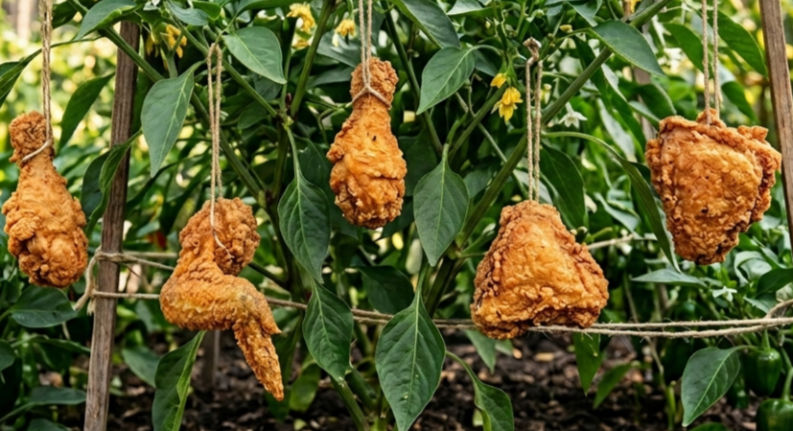
In 2023, photos of the gnarly, blistered, deeply contorted orange pods started circulating through chilihead communities. Comments flooded in saying the same thing: those pods look exactly like crispy fried chicken skin. The name BubbleSkin, which Italian breeder Rocco Maltesi had used since the pepper's creation around 2016, gave way overnight. The community had found a better one.
The name is perfect. That's the whole story of why this pepper is now everywhere.
But behind the viral moment is a pepper with legitimate credentials: elite parentage from two respected superhot lines, heat that crosses the 1,000,000 SHU threshold in lab testing, a flavor profile complex enough to earn attention from serious sauce makers, and a growth habit — tall, heavy-producing, high-yield — that growers genuinely want in a high-tunnel operation.
This is the full profile. Lineage first, then the heat, then the flavor, then what it actually grows like, and what it was called before it became famous.
Who Made It and Why That Matters
The Fried Chicken Pepper was created by Rocco Maltesi, an Italian master breeder with a documented record in the superhot community. This is not his first significant cross. Maltesi is also responsible for the Gator Jigsaw, which helped define what's now called the mustard superhot phenotype — a distinct visual and flavor category within the Capsicum chinense world. That context matters when evaluating a breeder's new work: Maltesi has demonstrated the ability to select for distinctive visual and flavor traits across multiple varieties, not just once.
Between 2016 and 2017, Maltesi crossed two Capsicum chinense varieties:
7 Pot Bubblegum, BBG7 Orange variant — one of the most extreme-texture superhots available, known for blistered, bubble-covered pod surfaces and earthy sweetness
Jay's Peach Ghost Scorpion (JPGS) — the Mennonite-farm Pennsylvania accidental cross of Bhut Jolokia and Trinidad Scorpion that delivers fruity aromatics, floral character, and aggressive ghost-family heat
The original name for the resulting cross was BubbleSkin — a direct reference to the pod's deeply contorted, bubble-like exocarp surface, which is the primary visible trait inherited from the BBG7 Orange parent. Seeds from the BubbleSkin were shared with a small group of elite growers starting around 2018, circulating quietly within the collector community before the broader discovery in 2023.
The Lineage: What Each Parent Contributes
Understanding the cross explains exactly why the Fried Chicken Pepper is what it is — both visually and in terms of flavor and heat profile.
7 Pot Bubblegum (BBG7 Orange)
The Bubblegum family is named for the bubble-like texture of its pod surface — an extreme wrinkling and blistering of the exocarp that is more pronounced than almost any other superhot variety. The BBG7 Orange variant brings:
Pod surface structure — the primary source of the fried-chicken-skin appearance; the deeply blistered, chaotic, almost sculptural wrinkle pattern is a Bubblegum signature
Earthy sweetness — a flavor depth that sets it apart from the sharp-citrus Scorpion profile and the floral ghost profile; this earthy-sweet note is what makes the Fried Chicken's flavor unusual among superhots
High capsaicin potential — the 7 Pot Bubblegum family runs consistently hot, contributing to the heat ceiling of the cross
Jay's Peach Ghost Scorpion (JPGS)
JPGS is one of the most thoroughly documented accidental crosses in the modern superhot era — discovered by Jay Weaver on a Mennonite farm in Pennsylvania where Ghost Pepper and Trinidad Scorpion rows grew adjacent and cross-pollinated through insect activity. It contributes to the Fried Chicken cross:
Fruity, floral aromatics — the citrus-grapefruit opening that reviewers consistently identify as the Fried Chicken's first flavor impression comes from the JPGS ghost lineage
Floral depth — the mid-palate floral note is a JPGS inheritance; ghost peppers carry this more pronouncedly than Scorpion varieties
Dual-source heat — JPGS itself stacks ghost-family slow-build heat with Scorpion-derived faster onset; that stacking carries forward into the Fried Chicken's layered burn progression
The result of combining these two parents is a pepper where neither parent is diluted into the other. The BBG texture is unmistakable. The JPGS aromatics are legible. They don't blend into something neutral — they layer into something genuinely complex.
For the full profile on the JPGS parent, the Jay's Peach Ghost Scorpion post covers the discovery story, lineage, and burn mechanics in detail.
Heat: Crossing the Million Mark
The community-documented heat range for the Fried Chicken Pepper is 850,000 to over 1,000,000 SHU. One independent lab test reported just over 1,000,000 SHU. SpiceQuest, which has run lab testing on the variety, estimates high-expression grows in the 1.3 to 1.5 million SHU range under optimal conditions.
A few honest notes on those numbers:
The 850,000 SHU floor reflects well-grown pods from lower-expression phenotypes or standard growing conditions. The 1.3–1.5M SHU estimates from high-expression grows are consistent with this variety's parentage — both BBG7 and JPGS are high-capsaicin lines — but represent upper-range potential, not population average. No published HPLC average exists for the variety as a whole.
The variety is also not fully stabilized, which means SHU variance between grow-outs is real and expected. Different seed sources trace to different selections of the original BubbleSkin line. A plant from a high-isolation, carefully selected seed stock will likely perform differently than one from a third-generation community grow-out.
What growers and reviewers consistently agree on is that the burn does not behave like its SHU range suggests. The description from SpiceQuest — one of the more precise flavor-and-heat write-ups available on this variety — captures it accurately: the burn builds rather than striking immediately, coats the entire mouth before concentrating into a needle-like sting on the front of the tongue, and lingers at a sustained level without the rapid fade some other superhots exhibit.
For context on why capsaicin oil content and dihydrocapsaicin ratios make some peppers feel hotter than their SHU suggests, the capsaicinoid biology post covers the mechanism in engineering terms.
Flavor: Three Layers Worth Staying Present For
This is where the Fried Chicken Pepper earns serious attention from sauce makers who have moved past novelty heat.
The flavor unfolds in a sequence that multiple independent reviewers have documented consistently enough to treat as a reliable profile:
Layer one — Citrus lead: The first impression is bright, grapefruit-forward citrus. It's clean, almost tropical, and arrives before the heat has meaningfully engaged. This is the JPGS ghost lineage speaking first.
Layer two — Floral mid-palate: As the citrus note settles, a deep floral character takes over — the kind associated with ghost-family peppers rather than Scorpion varieties, which tend toward sharper and less perfumed aromatics. This mid-palate transition is what makes the Fried Chicken distinctive.
Layer three — Earthy sweetness in the finish: The 7 Pot Bubblegum parent's contribution becomes most apparent here. There is a subtle, deep sweetness with an earthy undertone that keeps the flavor experience from becoming pure chemical aggression. It is a grounding note — the kind that sauce makers specifically look for when building a complex sauce where heat is a component rather than the entire point.
Then the burn activates fully.
Culinary applications where this profile performs well:
Fruit-forward fermented hot sauces — the citrus lead and floral mid-note play well against mango, pineapple, and tropical fruit bases
Vinegar-based sauces — the flavor complexity survives acidic environments better than single-note heat peppers
Smoked and dried applications — the earthy sweetness from the BBG parent concentrates in the drying process and holds in powder form
Compound applications — any preparation where you want superhot heat alongside readable flavor: chili oils, glazes, rubs on fatty cuts where capsaicin oil carries well
Pod Characteristics and Growth Habit
The pods at full maturity:
Color: Vivid orange — not the muted orange of some superhots, but a saturated, deep orange at full ripeness. Some pods show slight variation in shade depending on sun exposure during ripening
Surface texture: The defining characteristic. Deeply blistered, gnarly, contorted, and bumpy — the BBG7 parent's pod surface structure at full expression. No other common superhot produces this level of exocarp deformation. This is what you are looking at when you think "fried chicken skin."
Shape: Medium-to-large pods, typically 5 to 7 centimeters, rounded at the shoulder and tapering to a pronounced scorpion-style tail — the JPGS Scorpion lineage expressing itself in the pod tip
Wall thickness: Moderate — thicker than a pure ghost pepper, reflecting the Bubblegum parent's structural contribution
Oil content: High — visible on the cut surface at ripeness, consistent with the heat and flavor concentration the variety delivers
The plants:
Height: Consistently tall — 5 to 6+ feet reported across multiple grower sources. Support staking is frequently recommended for branch protection under heavy pod load
Yield: Heavy pod producers. Both primary sources (Super Hot Chiles and Unique Creek Homestead) flag this independently. High yield from a tall, vigorous plant is a commercially meaningful trait
Season: Long — approximately 120 days from seed to ripe fruit. This is standard for complex superhot crosses and consistent with both parent varieties
Stability: Partially unstable. Phenotypic variation between plants within the same grow-out is normal and expected. Pod texture intensity, heat level, and plant height can vary. This is not a defect — it reflects the variety's young age and the range of selections circulating in the seed community
From BubbleSkin to Viral: The Naming Timeline
Period | Event |
2016–2017 | Rocco Maltesi creates the BBG7 Orange × JPGS cross in Italy; names it BubbleSkin for the pod surface texture |
2018 | Seeds shared with elite growers including Jeff Hobbs; Alex Casillas begins distributing fresh pods from his grows |
2018–2022 | Circulates quietly among collectors and hardcore chilihead community; not widely known outside that circle |
2023 | Hobbs and Casillas post photos; community immediately compares blistered orange pods to fried chicken skin; name spreads organically |
2024–2025 | Seed vendors add it to catalogs; YouTube reviewers cover it; it appears across superhot collections; cemented as a modern staple |
The naming timeline is worth understanding for one specific reason: the Fried Chicken Pepper's rise is genuinely community-driven. No press release. No Guinness application. No marketing campaign. A breeder made something remarkable, shared it quietly, and the chilihead community named it and made it famous through organic photo sharing. That origin story is part of the pepper's legitimacy.
How It Compares to Its Parent Varieties
Variety | SHU Range | Flavor Lead | Pod Appearance | Notes |
Fried Chicken | 850K–1.5M+ | Citrus, floral, earthy | Extreme blistering; orange at ripe | Cross; partially unstable |
7 Pot Bubblegum (BBG7 Orange) | 1M–1.2M | Earthy sweet | Bubble-textured; orange | Source of pod texture and sweetness |
Jay's Peach Ghost Scorpion | 800K–1.1M | Fruity-floral | Gnarly, peach/orange | Source of aromatics and burn character |
7 Pot Primo | ~1.47M avg | Citrus-fruity | Stinger-tailed, blistered | Related family; higher documented SHU |
Carolina Reaper | 1.4M–1.6M avg | Fruity-sweet | Stinger-tailed, red | Higher certified average; different burn profile |
Harmony Springs Farmer's Note
By Gene Chumley | Head Grower, Harmony Springs Farm
2026 is our first season with the Fried Chicken in the high tunnel at Blountville, and the plants are tracking exactly where I expected them to be based on the grower data.
Height is coming in as advertised — we are already seeing strong vertical growth ahead of schedule relative to some of the other superhots in the same planting window. Branching is clean and vigorous, which is the structural indicator I watch for with any heavy-producing variety. A weak branching structure under a high pod load is how you lose yield to breakage late in the season. This variety is showing the kind of early stem diameter and node spacing that supports a heavy set without needing aggressive staking through the whole season.
The genetics here are not a mystery. Both BBG7 and JPGS are known quantities in our lineup — Jay's Peach Ghost Scorpion is an established performer for us — and the Fried Chicken is consistent with what you'd expect from that parentage at this stage. What I am watching is pod-set uniformity once we hit flowering. Partially unstable varieties can surprise you with phenotype spread at that point. We'll document it.
First harvest observations — flavor notes, burn progression compared to JPGS, and placental tissue density as an indicator of capsaicin concentration — will be added to this post when we pull ripe pods.
Join the list if you want to know when Fried Chicken plants are available.
If the Fried Chicken Pepper has you curious about what else we grow, the Fresh Superhot Variety Mix is the answer. It's a hand-picked selection of whatever's at peak ripeness in our high tunnel on harvest morning — Reaper class heat, Scorpion variants, farm originals, and whatever else is ready that day. Ships July 15.
If you want bulk variety for sauce production, the 3 lb Professional Variety Mix is the move — hand-picked mix of whatever's at peak heat that morning, ships July 15 in sauce-maker quantity.

Precision Grown. Engineer Verified.
Frequently Asked Questions: Fried Chicken Pepper
What is the Fried Chicken Pepper? The Fried Chicken Pepper is a Capsicum chinense superhot created by Italian master breeder Rocco Maltesi around 2016–2017. It is a cross between the 7 Pot Bubblegum (BBG7 Orange) and Jay's Peach Ghost Scorpion. It is named for its deeply blistered, gnarly pods that visually resemble crispy fried chicken skin. Heat ranges from approximately 850,000 to over 1,000,000 SHU with some high-expression grows estimated higher.
Who created the Fried Chicken Pepper? The Fried Chicken Pepper was created by Rocco Maltesi, an Italian master breeder known for producing elite superhot crosses including the Gator Jigsaw. Between 2016 and 2017, Maltesi crossed the 7 Pot Bubblegum (BBG7 Orange) with Jay's Peach Ghost Scorpion, originally naming the result BubbleSkin. Seeds were shared with elite growers around 2018 before the pepper gained its current name in 2023.
How hot is the Fried Chicken Pepper? The Fried Chicken Pepper is a true superhot with a documented heat range of 850,000 to over 1,000,000 SHU. One independent lab test reported just over 1,000,000 SHU, with some high-expression grows estimated at 1.3 to 1.5 million SHU. Because the variety is not fully stabilized, heat output varies between plants and grow-outs. Growing conditions, soil mineral content, and sun exposure all affect expressed SHU.
What does the Fried Chicken Pepper taste like? The Fried Chicken Pepper has a complex, layered flavor: bright citrus and grapefruit on first contact, followed by deep floral notes mid-palate, with a subtle earthy sweetness inherited from the 7 Pot Bubblegum parent. The burn builds gradually, coating the mouth before concentrating into a sustained sting. Reviewers consistently describe it as one of the most flavor-complex superhots available.
Why does the Fried Chicken Pepper look like fried chicken? The deeply blistered, gnarly, contorted pod surface is inherited from the 7 Pot Bubblegum parent, which is specifically known for its extreme exocarp wrinkling. At full ripeness, the orange pods with irregular raised blisters and ridges closely resemble crispy fried chicken batter. The name originated in 2023 when growers Jeff Hobbs and Alex Casillas shared photos and the chilihead community made the comparison. The original name was BubbleSkin.
What are the parent peppers of the Fried Chicken Pepper? The Fried Chicken Pepper is a cross of two Capsicum chinense varieties: the 7 Pot Bubblegum (BBG7 Orange variant) and Jay's Peach Ghost Scorpion. The 7 Pot Bubblegum contributes the extreme pod surface texture, earthy sweetness, and high capsaicin potential. Jay's Peach Ghost Scorpion contributes fruity and floral aromatics, the ghost-family burn character, and additional heat ceiling.
Is the Fried Chicken Pepper stable? The Fried Chicken Pepper is still considered a young and partially unstable variety. Multiple phenotypes exist across grower populations. Pod shape, blistering intensity, heat level, and plant structure can vary between plants in the same crop and between different seed sources. This genetic variability is part of its appeal for collectors and breeders.
Can I buy Fried Chicken Peppers from Harmony Springs Farm? Yes. Harmony Springs Farm grows the Fried Chicken Pepper in its high-tunnel operation in Blountville, Tennessee. Frsh peppers are available during the harvest season while supply lasts. Join the notify list on the product page to be alerted peppers are in stock.


Comments